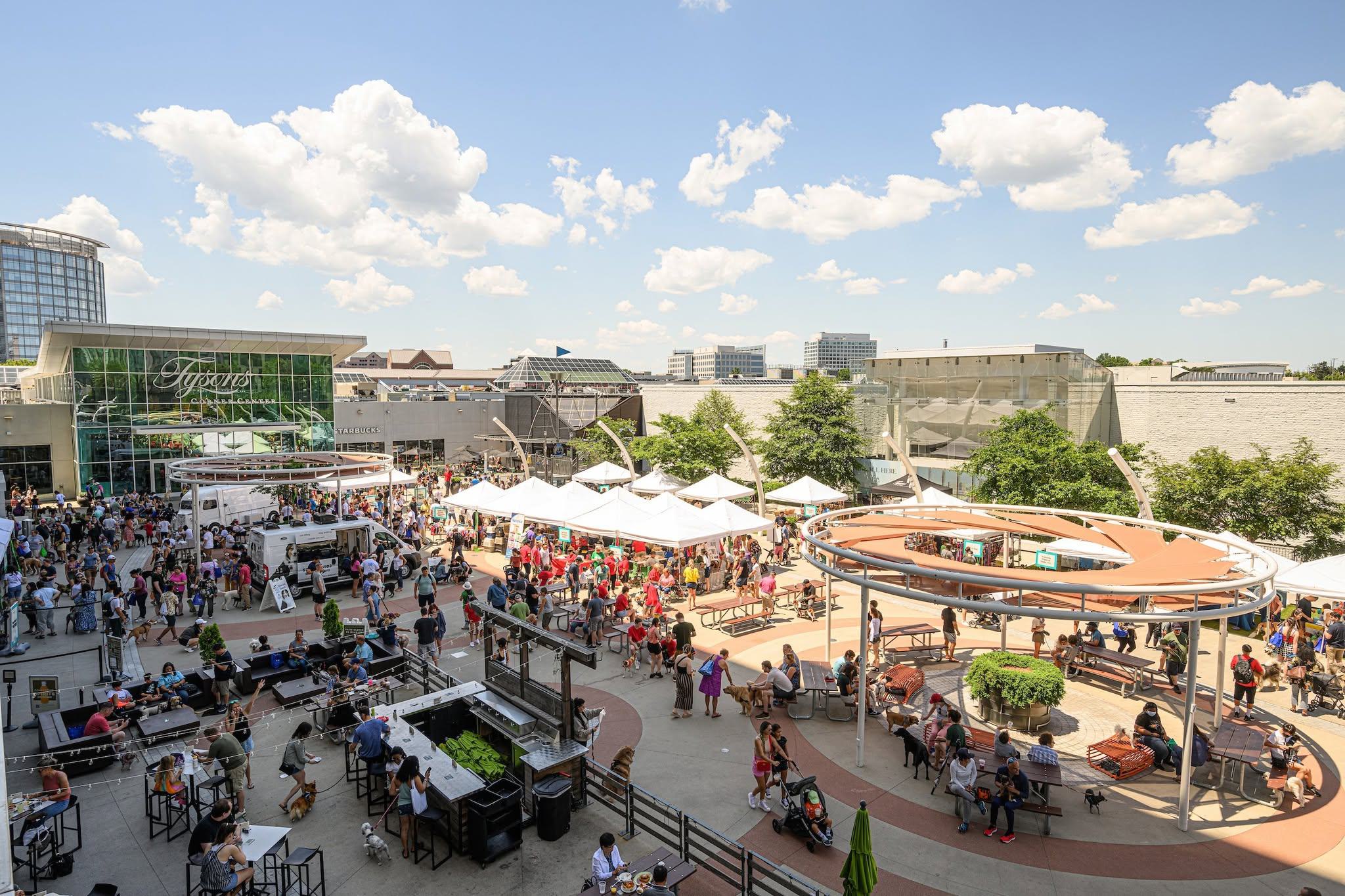
Photo Credit: Tysons Corner Center
Evolution & Growth
To understand Northern Virginia’s modern landscape, you have to look at Tysons. For decades, it was a bit of a contradiction: it held some of the most valuable retail and commercial real estate in the country, yet didn't feel like city. Why? Because it was an unincorporated area with no local mayor or city council, the initial layout wasn't planned well in advance. Instead, it grew up around major highways and corporate office parks.
In short: Tysons used to be known for fancy retail and big companies, but it wasn't a place where people actually lived or walked.
Now, that car-centric model is shifting. In fact, it’s undergoing one of the most radical vertical urban transformations in the country. Powered by the Metro Silver Line expansion and a new long-term master plan, Tysons is steadily transforming into a walkable, high-density, energetic urban center.
The arrival of the Metro wasn't just about giving people an easier commute to D.C.; it completely unlocked billions of dollars in high-density development.
While Tysons remains famous for its shopping malls and corporate footprint, its identity today is equally shaped by its new, pedestrian-friendly, people-focused neighborhoods.
1. World-Class Shopping
If people outside of Virginia know Tysons, it’s almost certainly for the shopping. Two massive malls sit directly across the street from each other, but they offer completely different experiences.
Tysons Corner Center: The Massive Mega-Mall
Opening back in 1968, Tysons Corner Center has grown into a giant. Featuring around 2 million square feet of core retail space (reaching 2.4 million total square feet including its modern transit towers), it’s the largest mall in the D.C. area and ranks as one of the top 10 largest shopping malls in the United States.
It draws up to 20 million visitors a year—making it the number-one tourist destination in Northern Virginia—and has a long history of pulling off major retail firsts:
- The World's First Apple Store: Steve Jobs chose this exact mall to open the world's very first physical Apple Store on May 19, 2001 (beating out a California location by a few hours thanks to the East Coast time zone).
- Nordstrom’s East Coast Debut: In 1988, the mall landed the very first Nordstrom location east of the Mississippi, permanently cementing Tysons as a major high-end retail player.
Today, it’s famous for mixing big-name shopping with unique experiences:
- Giant Flagship Stores: Huge, multi-level spaces for brands like Zara, Uniqlo, and Nordstrom.
- Things to Do (Not Just Buy): The mall has turned massive spaces into entertainment hubs. You’ll find Level99 (a 40,000-square-foot social gaming and challenge arena) and Sloomoo Institute (an immersive sensory playground).
- PenFed Plaza: A lively, elevated outdoor plaza that connects the mall directly to the Metro station, hosting outdoor dining, summer concerts, and winter ice skating.
Tysons Galleria: High-End Luxury
The Galleria is famous for landing exclusive, high-end fashion houses that you won’t find anywhere else in Virginia. Nicknamed "The Rodeo Drive of the East Coast", it gets rare pieces that usually only ship to places like New York City:
- Designer Brands: Standalone boutiques for Chanel, Gucci, Prada, Dior, Balenciaga, and Saint Laurent.
- Luxury Watches: It’s a major hub for high-end timepieces, featuring dedicated shops for Cartier, Breitling, and IWC.
- Upgraded Eats: Instead of a traditional food court, you'll find a luxury dine-in movie theater (CMX CinéBistro) and a curated third-floor Food Hall featuring popular local spots like Andy’s Pizza, Scolapasta, and Rabbit Taco.
- Elevated Dining:Instead of a traditional food court, you'll find a luxury dine-in movie theater (CMX CinéBistro) along with a mix of upscale site-down restaurants and popular local favorites like Andy’s Pizza, Scolapasta, and Rabbit Taco.
- The Ritz-Carlton Connection: The entire mall is physically connected to The Ritz-Carlton hotel, an added convenience for traveling celebrities, executives, and international shoppers..
- Weekend Car Spotting: On any given weekend, the Galleria's parking lots may hold rare Ferraris, Lamborghinis, and supercars driven by the mall's elite clientele.
2. America's "Next Great City" & The Silver Line
Before 2014, Tysons faced a massive problem. It was the state’s second-largest employment center, yet it was gridlocked and hostile to anyone without a car.
The Metro Silver Line changed everything by:
- Easing Traffic: By linking Fairfax County directly to downtown D.C. and Dulles International Airport, the Metro pulled thousands of cars off the asphalt—giving planners the physical breathing room to design walkable, pedestrian-friendly spaces.
- Sparking New Development: Outdated spaces are quickly being replaced by high-rise apartments, lively public plazas, and parks. It's funneled billions into what is now one of the country's most radical vertical transformations.
Tysons' new transit stations created distinct, dynamic districts that include:
- Capital One Center (McLean Station): A corporate campus turned public hub. It blends a global banking headquarters with street-level retail, a performing arts hall, and open public spaces.
- The Mall District (Tysons Station): The central retail core of the city, placing visitors steps away from the shopping, flagships, and outdoor events at Tysons Corner Center.
- The Boro (Greensboro Station): A compact urban village featuring luxury residential towers, corporate offices, outdoor dining, and a massive flagship Whole Foods.
- The Next Wave (Spring Hill Station): Luxe new residential towers like Adaire are being complemented by exciting projects like the Tysons Community Center and other innovative mixed-use developments.
Tysons is now entering a phase of enhancement. Instead of just breaking ground on empty lots, developers are heavily investing in rewriting the spaces between buildings—adding plazas, catwalks, and walkability to tie the city together.
3. The Powerhouse Corporate Hub
Tysons has more office space than many major U.S. city centers—clocking in at roughly 30 million square feet. It's a massive economic engine often called the "Silicon Valley of the East" because of its heavy concentration of tech, defense, and corporate headquarters.
Tysons is an absolute economic powerhouse, boasting a trophy office vacancy rate well below national averages because companies genuinely want to be here. A few of the major names driving the local ecosystem include:
- Capital One: Their soaring corporate campus fundamentally shapes the skyline and serves as the visual anchor for the city.
- Hilton Worldwide: Headquartered right here, keeping Tysons anchored at the center of the global hospitality sector.
- Booz Allen Hamilton & MITRE: Highlighting the area's massive ties to defense, cybersecurity, and federal contracting.
- Freddie Mac: Driving a huge population of finance and housing professionals directly into the local economy.
- The Tech Pioneers: Heavy hitters like Strategy (formerly MicroStrategy), Appian, and Cvent run massive global operations from here, while satellite communications giant Intelsat anchors the aerospace and tech ecosystem.
While standard, older office parks across the country are facing major challenges right now, Tysons is seeing a massive "flight to quality." Top-tier employers are aggressively competing for the area's "Trophy" class offices—ultra-modern, highly amenitized spaces located right next to the Metro—while leaving older, isolated commuter buildings behind.
4. Next-Level Retail & The $100M Culinary Wave
Tysons has long been the shopping capital of the region, but the biggest shift right now is in premium food and entertainment. Shedding its old reputation as a place that shuts down at 5:00 PM, Tysons is building a true night-and-weekend economy.
Established Rooftop & Arts Nightlife: Right at Capital One Center, you have the pillars that kickstarted Tysons' transformation from a 9-to-5 commuter hub into a legitimate evening destination. This includes The Perch—a full public park built 11 stories up in the sky featuring Perch Putt (rooftop mini-golf) and the Starr Hill Biergarten—and Capital One Hall, the world-class performing arts center that brings major Broadway shows and concerts right to the Silver Line.
The Dining Scene: Tysons is drawing upscale, experiential concepts once reserved for D.C. The neighborhood near Greensboro station has evolved into a foodie hub anchored by a flagship Whole Foods, the curated local flavors of Fava Pot, and Churasuko—a brand-new Japanese-Brazilian fusion steakhouse serving tableside Wagyu. At the McLean Metro node, Shipgarten offers a casual outdoor alternative built from shipping containers with a sprawling biergarten, live music, and a dog park. For true exclusivity, The Naisho Room operates as an intimate, hidden cocktail lounge and 8-seat premium Omakase bar tucked away on the 25th floor of The Watermark Hotel.
The $100 Million Transit Plaza & Dining Flagships: Tysons Corner Center is undergoing a massive redevelopment right at its Metro entrance to create an at-grade pedestrian plaza. The absolute crown jewels anchoring this transformation are global culinary heavyweights Eataly (which just secured its major construction permits) and Din Tai Fung, connecting food lovers directly to the Silver Line. Adding to this mall-wide dining boom is Maggiano's Little Italy, which recently closed its 30-year Galleria location to open a massive, 17,000-square-foot flagship near the Coastal Flats entrance.
Interactive & Gaming: Tysons has traded traditional retail for huge social entertainment hubs. Tysons Corner Center now features Level99, a massive 40,000-square-foot adult playground with over 50 immersive escape-room-style challenges and a 300-seat Victory Brewing taproom. Nearby at The Boro, Game Show Battle Rooms hosts live, TV-style trivia competitions, while the mall’s upcoming multi-sensory Sloomoo Institute is set to anchor the family-friendly side of the market.
The Mega Sports Centers: Under Armour just unveiled its first-ever Sports House flagship—a heavily reimagined retail concept designed like an athlete's training tunnel and innovation lab. Meanwhile, a staggering 196,000-square-foot Dick’s House of Sport complex is actively under construction in the old Lord & Taylor wing. Slated for a Fall 2027 opening, that massive multi-level destination will bring real physical experiences directly into the mall, including indoor rock-climbing walls, golf simulators, and an outdoor turf field.
5. Tysons History & Local Insights
Behind the modern skyline lies a unique mix of early internet history, civic paradoxes, and hidden local spaces that shape the area's distinct identity.
The Early Internet Hub (MAE-East): While Tysons is well known for its current tech corridor, it played a foundational role in the growth of the commercial internet. In the early 1990s, an unassuming office building at 8100 Boone Boulevard housed MAE-East (Metropolitan Area East). At its peak in the mid-to-late '90s, roughly 50% of all global internet traffic passed through this single exchange location, routing international data lines through Tysons well before nearby Ashburn became the region's primary data hub.
The Civic Paradox: Despite a dense skyline, more corporate office space than downtown Miami, and an economic output that rivals major American cities, Tysons is not legally a city or a town. It remains an unincorporated "Census-Designated Place" governed entirely by Fairfax County. Lacking a local mayor, city council, or municipal police force, its modern high-density urban planning is managed as a large, continuous suburban district.
The Commuter Imbalance: A primary focus for local real estate developers is balancing the area's stark population shift between day and night. Tysons holds a permanent residential population of approximately 25,000 people. However, during the standard work week, that number swells to well over 100,000 as corporate employees commute into the area.
Innovative new residential hubs like The Boro and Adaire are designed to convert daily commuters into full-time residents to support a true 24/7 local economy.
From Fruit Orchards to Cold War Infrastructure: In the 19th century, the local crossroads were known as Peach Grove, named for the extensive fruit orchards owned by local postmaster William Tyson. Decades later, the military utilized the area’s high geographical elevation to construct the iconic red-and-white Tysons Corner Communications Tower (Site E) in 1952. Built by the U.S. Army during the Cold War, this secure microwave relay station was engineered as a vital communication link between Washington, D.C., and alternate command facilities to ensure the continuity of government.
The Future of Tysons
Tysons is evolving into a network of vibrant, walkable residential-slash-commercial hubs, transforming the area into a dynamic, desirable, and super-convenient place to live.
You can see this shift happening right around the Spring Hill Metro station. The 34-story Adaire tower brings soaring, sustainable, LEED-Gold style to the area, and now new projects are filling in the rest of the street grid. Just down the block, construction is moving fast on The Exchange at Spring Hill Station, which is bringing a 30,000-square-foot county community center to the neighborhood.
The area around the station is fast becoming a true, connected neighborhood where you can easily walk to dinner, the gym, and the train. You'll also find a surprising abundance of hidden trails and parks within a few minutes of Adaire—a green reality that reflets Fairfax County’s renewed focus on creating walkable, sustainable communities.
Explore modern, one-of-a-kind apartments at Adaire, where you'll find floor-to-ceiling views, abundant amenities, transit ease, nearby green spaces, and the exciting energy of Spring Hill.